The post is titled SPANKIN NEW RENDERINGS and its entire text is one line: “The first one is for fun but the second one is part of the interiors we are doing for an apartment to be built in Gambia.” It went up on 1 July 2009 and was revised the same morning. Unusually for the studio’s 2009 output it carries labels — 3d visualization, architecture, portfolio, sketchup, v ray — which is where the Software row comes from. The prose itself names no client, no designer, no city and no piece of software.
Two frames were published and one is plated, because the post separates them. The first is a living room at 700 by 374, and the studio calls it a diversion — something done “for fun”. This frame is the one it attributes to the Gambia apartment. Putting both on one project page would claim a living room the source explicitly says is not part of the job, so the other frame is left out and named here instead.
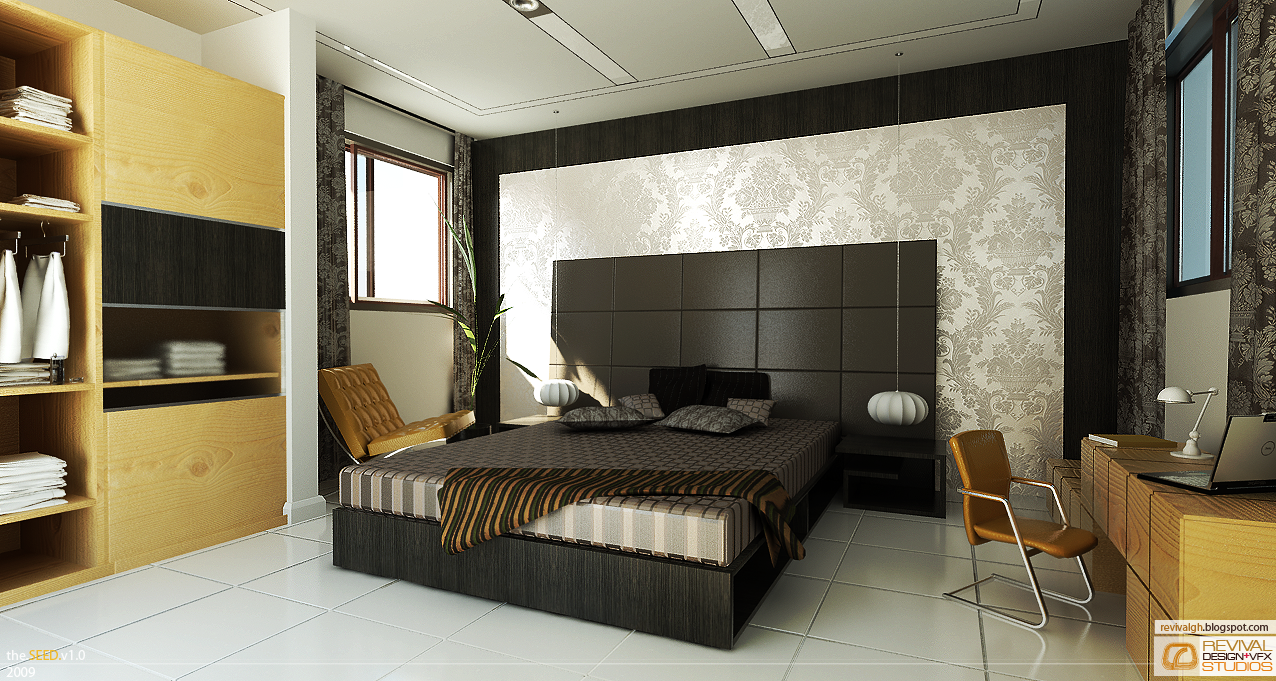
The room is built on a dark-and-silver palette. A low platform bed sits against a headboard of four large upholstered panels, fixed onto a wider panel of pale damask wallpaper that fills the middle of the wall like a framed picture, with dark timber-look panelling running floor to ceiling around it. Two white paper lanterns hang on long drops either side in place of bedside lamps. A pale pine unit at the left combines open shelving stacked with folded linen, a hanging rail with shirts and a bank of dark drawer fronts; at the right a matching pine desk carries an open laptop and a small chrome task lamp, with a tan leather chair on slim steel legs tucked under it and a second tan lounge chair angling in near the window. The floor is large glossy white tile and the ceiling is coffered with recessed spots.
The frame carries the studio’s own signature, which is what dates it: bottom left reads the.SEED.v1.0 over 2009, bottom right revivalgh.blogspot.com above the REVIVAL DESIGN+VFX STUDIOS lockup. That puts it in the same signature run as White and Unassuming of 15 May 2009 and Somewhere in East Legon of 27 May, both published in the weeks before this post, and the furniture vocabulary is shared across all three — low platform beds, paper lanterns, chrome task and arc lamps, high-gloss pale floors, dark feature panelling. East Legon’s bedroom carries a large mauve damask behind its bed, so the two jobs use the same device even where the pattern differs.
Nothing after this post mentions Gambia: searching the studio’s hundred-and-twenty-two surviving entries for the word returns this one alone, and this frame’s filename occurs nowhere else either. The phrase “part of the interiors we are doing” promises a set, and only this one frame of it was ever published, so the page carries a single plate and a Status row saying the building is not recorded. The country is given as Gambia because the post gives Gambia; no city, district or street is named anywhere, so none is invented, and the client is named nowhere, so the row carries a Private Client. The source post is on blogspot — SPANKIN NEW RENDERINGS, 1 July 2009.